
A Life of Service and Leadership: For the past 45 years, Mark and Gay Maloney have made an impact locally, regionally and internationally through Rotary
By Catherine Godbey | Living 50 Plus
Mark Maloney runs through the list of “What ifs.”
What if, after law school, he accepted a job in Nashville rather than moving to Decatur to practice law with his wife’s father, J. Gilmer Blackburn?
“Never would Mark have been able to work his way up through Rotary if he had been working at a law firm in a big city,” lawyer Gay Blackburn Maloney, Blackburn’s daughter and Maloney’s wife, said.
What if Hack Ross, who served as president-elect for the Rotary Club of Decatur, had not received a promotion from Wolverine Tube and had to resign his position? That led to Mark serving as president-elect in 1984-85 and as president in 1985-86.
What if Byron Nelson, the former superintendent of education for Decatur City Schools and former district governor of Rotary’s north Alabama area, had been unable to convince a group of Rotarians from Nigeria to visit Decatur? That led to Mark leading a five-person team to Nigeria in 1986.
What if Bill Johnson, a member of the Rotary Club of Shades Valley, had decided to run for district governor opposite Maloney? Johnson stepping aside led to Mark running unopposed as district governor.
“There are so many individual people who were so instrumental on my journey in Rotary,” Mark, 70, said. “I would’ve never been president-elect in 1984 if Hack Ross had not resigned. The Nigerian team was not supposed to come to Decatur, but Byron Nelson made it happen. If the team had not come to Decatur, I would not have gone to Nigeria and who knows when I would have been district governor. Bill Johnson stepped aside so it would be clear I would be district governor. I owe a lot to those people.”
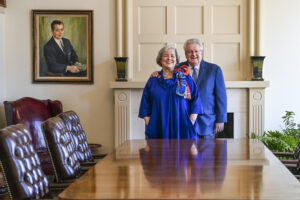
Sitting in the room known as the Rotary Archives — the late J. Gilmer Blackburn’s former office at Blackburn, Maloney & Schuppert in downtown Decatur — Mark recounted his journey from his childhood growing up on a farm in the 850-person town of Ridgway, Illinois — “It made Lawrence County look like a metropolis,” he said — to attending Harvard University to joining the Rotary Club of Decatur in 1980 to his term as president of Rotary International in 2019-20 to serving as chair of the trustees of the Rotary Foundation, a $1.5 billion entity, in 2024-25.
Gifts Mark and Gay received travelling the world while Mark served as president-elect and president of Rotary International and chair of the Rotary Foundation fill the room.
There is a portrait of Mark and Gay made to look like a painting from Taiwan.
There is a painting depicting the day the Virgin Mary appeared to children in Fatima, Portugal, and the sun danced in the sky created by a student at an institution for developmentally disabled individuals supported by the Rotary Club of Fatima.
There is a gourd and spoon from Abuja, Nigeria, given to the Maloneys during a community event organized by Rotarians in an effort to reduce maternal and infant deaths.
There is a hand-stitched landscape created by a Rotarian in Ukraine.
There is a walking stick from Ireland.
There is a figurine of Mark in a “Harry Potter” robe — a nod to Maloney’s “Mark’s Magical Markers” speech given during the 2024-25 year themed The Magic of Rotary.
Across the room from the Rotary Archives hang clothes handmade for the Maloneys from Nigeria, Ghana, Korea and other countries.
The Maloney’s travels have taken them to 50 to 60 counties, including Japan, Hong Kong, Singapore, Malaysia, Turkey, Rome, Vatican, Denmark, Sweden, Finland, Argentina, Chile, Brazil, Norway, United Kingdom, France, Austria, Switzerland, Australia, Japan, Spain, Czech Republic, Nigeria, Romania, Hungary, Pakistan, India, England, Indonesia, Ireland, Korea, Canada, Nigeria, Ghana, Azerbaijan, Vietnam and Taiwan.
Mark met world leaders — presidents, vice presidents and three popes, including Pope Leo XIV during the Jubilee of Rotarians in Vatican City in December.
Mark and Gay witnessed the impact of Rotary firsthand. They saw an Operation Smile operation to repair a child’s cleft lip in Vietnam, they learned about eye operations in Turkey and visited a high school business studies lab in Nigeria where students, before receiving computers and keyboards, learned to type using a cardboard keyboard.
“It’s remarkable to see and experience the world from the inside, not just to be visitors or tourists, but to be able to see how people really live and support their communities. Rotary allowed us to be part of the world. It’s been pretty incredible,” Gay said.
A native of Decatur, Gay, the daughter of Phyllis and J. Gilmer Blackburn, who served as mayor from 1962-68, grew up with dreams of traveling the world.
“My first step to seeing the world was going to Agnes Scott College in Decatur, Georgia,” said Gay, who served as editor of the yearbook and participated in service organizations at Decatur High School.
After earning degrees in English and art from Agnes Scott College, she applied for and was accepted to Vanderbilt Law School.
“Growing up, I never considered being a lawyer. For young women at that time, there were no women lawyers in Decatur. It was more of a concept that if I were a young man, I may go to law school because my father was a lawyer,” Gay said. “At Agnes Scott, I realized I could practice law.”
In her second year at Vanderbilt, Gay, who served as president of the Student Government Association, met Mark in a seminar on public international law.
Mark’s path to Vanderbilt began in southern Illinois on a wheat, corn and soybean farm run by his father and two uncles. While he participated in 4-H competitions — mainly the public speaking components — he never foresaw a future in farming.
“I was never cut out to be a farmer. One of the most horrifying things you could imagine is me walking across the farmyard with a wrench in my hand like I was going to try to fix something,” Mark said.
At age 11, Mark won the blue ribbon in the 4-H competition for public speaking at the Illinois State Fair for his speech, “A Dream Becomes a Goal” about his desire to become a doctor.
“Then I started thinking about blood and guts and all that,” Mark said. “One of my parents’ close friends was a lawyer, so at 12 or 13, I decided I wanted to be a lawyer and never looked back.”
An organizer and leader by nature, Mark served as president of Ridgway High School’s student government association, president of the county’s 4-H federation, state officer for the National Beta Club, president of the Catholic Youth Organization for the Roman Catholic diocese of Belleville, Illinois, and was appointed to the Illinois Council of Youth.
During his eighth grade year, Mark applied to Chaminade, a Catholic prep school in St. Louis, three hours from Ridgway, was accepted and received a full scholarship.
“But I was only 13,” Mark said. “My mother was not ready to let me go to St. Louis. I went to the local public high school with 200 students instead. Because I didn’t take advantage of going to prep school, my parents said they would send me to the best college I could get into.”
He applied and was accepted into the University of Illinois — the state land grant school — Vanderbilt, which was three hours from his home, Notre Dame — an obvious option for Mark, an Irish and Catholic Midwesterner — and two Ivy League schools, Dartmouth and Harvard. He chose Harvard.
After graduating from Harvard, Mark’s journey to becoming a lawyer led him to Vanderbilt.
At the start of his second year in 1977, Mark took five of his classmates to his hometown of Ridgway — the self-proclaimed Popcorn Capital of the World — for Popcorn Day, a fall festival held the second Saturday in September.
“The Monday after Popcorn Day, one of the guys pulls out a bag of popcorn in class. Well, that starts a conversation on interesting hometown things and one of our classmates pointed out that Gay’s hometown has a wave pool. Shortly after that I asked her out for a date and was turned down,” Mark said.
“I already had a date,” Gay said.
After Mark realized he had the wrong date for the event he wanted to take Gay to, he asked again. This time she accepted. By April 1978, Mark and Gay were engaged.
When Mark and Gay neared the end of law school, Blackburn pitched the benefits of living in and practicing law in a small town, such as Decatur, to the couple.
“He made it clear that Decatur was a good place to raise a family and we would come into an established position. We actually agonized over the decision,” Mark said.
After discussing the possibilities over with Gay, Mark, who received job offers in larger cities, planned on joining a firm in Nashville.
“I had an appointment with them one afternoon and the appointment was made with the idea that I was going to accept the offer. When I got up that morning, I thought I was going to accept it, but by that afternoon, I knew we were supposed to come back to Decatur,” Mark said. “In the beginning, we thought we were doing Gay’s parents a favor coming home. We were foolish young people. They were the ones actually doing us a favor.”
From Blackburn, a sole practitioner for 25 years, mayor of Decatur for six years, president of the Kiwanis Club of Decatur for a year and president of the Auburn National Alumni Association for two years, Mark and Gay, like many in Decatur, learned about paying their “civic rent.”
“He very much believed in paying your civic rent — that there was an obligation you had to the community just for you being a part of the community. He infused that in us,” Mark said.
As did Blackburn’s wife, Phyllis.
“My mother was the same way. She was always giving back to the community in some way,” Gay said.
Following Blackburn’s lead, Mark, then 25, joined the Rotary Club of Decatur, an all-men’s club at the time, on Dec. 12, 1980.
Three years after joining the club, Mark was elected to serve on the board of directors. He took office in July 1984. Four months later, Hack Ross, the president-elect, resigned.
That set in motion Mark’s journey up the Rotary leadership ladder.
“Tradition was you went to the next person in seniority on the board. Well, I was the youngest one. For whatever reason, it got down to the person ahead of me — Bill Wyker. He said he wanted to be president-elect, but he was to be the chair of the United Way fundraising campaign and he couldn’t do both. The only one left on the board was me,” Mark said.
Mark served as president-elect for the Rotary Club of Decatur from November 1984-June 1985 and as president the next year. During his year as president, a Rotary group study exchange team from Nigeria visited Decatur for 48 hours.
“They were a team of Black Africans in the South. Some other places were not as welcoming to them. In Decatur, we went all out. We had a catered dinner by Russell Priest at our home and I went around with them. They felt very welcome. Two days after they left, I got a phone call from a district leader saying the team leader suggested that I should be a team leader to take a group back to Nigeria the next year,” Mark said.
In October and November of 1986, Mark spent 40 days in Nigeria.
“I’m seeing Rotary in a completely different context. I saw Rotarians deeply involved in service projects, many which were founded with grants from the Rotary Foundation, in their communities,” Mark said.
Of the seven Nigerian families he stayed with, two had children with polio. In 1985, Rotary International made a commitment to immunize all the children in the world against polio. (In 1988, there were 350,000 new cases of polio every year and polio was endemic in 125 counties. Last year, there were less than 40 new cases and the disease was endemic in two countries.)
“During that trip, I saw the good that Rotarians were doing,” Mark said. “When we came back, our team went to different Rotary clubs to share what Rotary was like in Nigeria and I got to be known around the district.”
A year later, Mark submitted his name in the election for district governor for the northern half of Alabama. He ran unopposed and became more known in the organization.
After his one-year term as district governor, Mark served as an organizing committee member for an annual meeting for Rotary leaders, on the board of directors from 1999-2001, as presidential aide to Jonathan Majiyagbe of Nigeria in 2003-04, as a trustee of the Rotary Foundation from 2004-08, as a member of the Future Vision Committee from 2008-14, as chair of the Council on Legislation in 2010, as chair of the Rotary International Convention in Sydney in 2014 and as chair of the operations review committee.
In August 2017, Mark was nominated to become president of Rotary International.
“I put my name in four times. Back then, if you were from the United States, by tradition, you could only put your name in once every three years. So, I put my name in in 2008, 2011, 2014 and 2017,” Mark said.
He served as president-elect in 2018-19 and as president of the 1.2-million-member organization in 2019-2020.
One of those members was Gay.
In 1996, with Mark’s support, Gay helped found the Rotary Club of Decatur Daybreak.
“We are both organizers and leaders. We are two peas out of the same pod, but, sometimes, it’s important that we have our own pod to organize,” Gay said, who also served as president of the Junior League of Morgan County, president of the United Way, president of the Agnes Scott Alumnae Association and on the board of trustees for Agnes Scott College.
Gay decided to join Rotary after attending a trustee meeting at Agnes Scott College.
“At that time, Mark and I had done a lot of traveling with Rotary and the other trustees who were Rotarians would invite me to meetings. I would have to tell them, ‘I’m not a Rotarian.’ I came back from one of those meetings and told Mark it was time, but I needed my own space,” Gay said.
On March 6, 2026, the Rotary Club of Decatur Daybreak will celebrate 30 years.
During Mark’s tenure as president of Rotary International, the Maloneys rode the Rotary float in the Rose Bowl Parade, visited Fukushima, Japan – the site of a nuclear disaster in 2011 – were “married’ in a traditional wedding ceremony in Korea and sat with the royal family at Westminster Abbey during a commonwealth service.
“We followed one of the Spice Girls in the church. All of the paparazzi were taking pictures and then we walked up and the cameras went down. They had no idea who we were,” Mark said with a laugh.
On March 11, 2020, Mark and Gay packed their suitcases thinking they would travel from London to Zurich. But, the next day, they flew back to Chicago as COVID-19 shut down the world.
“We came home and spent the next 101 consecutive nights in our own bed. I don’t know if any president of Rotary International has done that,” Mark said.
“But, while COVID stopped our travels, what we witnessed during that time was remarkable. We saw Rotarians around the world step up to help their communities. That was remarkable,” Gay said.
As president, Mark also spearheaded the inclusion of the environment as an area of focus for the Rotary Foundation. As an area of focus, environmental projects are eligible for foundation grants. A sculpture of the Earth with the message, “The Earth thanks you for making the environment the seventh area of focus,” sits in the Rotary Archives room.
A year after stepping down as president, Mark began a four-year term as a trustee for the Rotary Foundation. In 2024-25, he served as chair of the Rotary Foundation and oversaw the completion of the organization’s $2.025 billion in the 2025 fundraising campaign.
“Ten years before I was chair, the then trustees established a goal of increasing the endowment to $2 billion. I ended up being the chair at the time that needed to be finished. When I became chair, we were more than a quarter billion dollars short and we made it. We had the greatest fundraising year in the history of Rotary,” Mark said. “We had an internal fundraising goal of $500 million and got $569.5 million.”
Along with J. Gilmer and Phyllis Blackburn, who introduced them to paying a “civic rent,” which extended to Mark’s work with the Catholic community, serving on St. Ann’s school board and on Annunciation of the Lord’s finance council, and Gay’s participation at First United Methodist, where she sings in the choir and worked on their endowment, the Maloneys credited Ken and Lynn Schuppert, their partners at Blackburn, Maloney & Schuppert, for supporting their rise in Rotary.
“We owe a huge debt of gratitude to Ken and Lynn. We never stopped working, but, obviously, we were not working as much. We appreciate how much they supported the clients of the firm while we traveled,” Gay said. “We are also very appreciative of how the community of Decatur has supported us and how welcoming our community has been when we have brought international visitors home.”
Through their experiences, travels and people they met, the Maloneys are forever changed by Rotary.
“I think we’re very understanding of different cultures and of different situations because of Rotary. You can’t always look at things from the American perspective to fully understand what is going on. When I was president, I chose the theme ‘Rotary Connects the World.’ To me that is the greatest thing about Rotary — the connections and friendships we made,” Mark said.
“Our experiences have shown us the best of humanity: individuals who not only dream of a better world, but who also commit to making their dreams a reality, both locally and globally. These experiences of service are available not only to the leadership in Rotary, but also to each member of a Rotary Club,” Gay said.
An exhibit featuring garments, textiles, art and artifacts gifted to Mark and Gay during their Rotary travels will be on display at the University of North Alabama’s Elaine Baily Augustine Art Gallery, May 15-July 15. An opening reception will take place May 16 at 2 p.m.